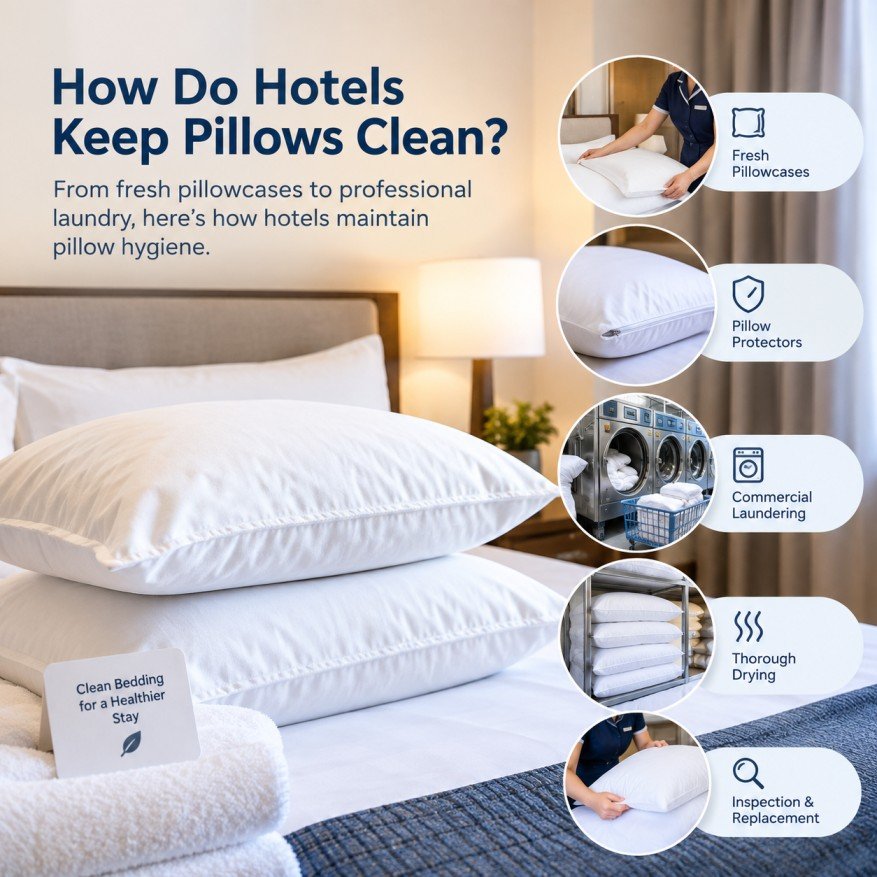
Hotels keep pillows clean through a three-layer system: a washable protector worn under the pillowcase, high-heat industrial laundering at 60–90°C for the pillowcase and protector, and a scheduled replacement cycle that swaps out pillows every 12–24 months.
Pillowcases are washed after every guest checkout at nearly all reputable hotels, while the pillow itself, protector included, is deep-cleaned or replaced on a rotating schedule, typically every 3–6 months at mid-range hotels and more frequently at luxury properties.
That’s the short answer. But if you’ve ever face-planted into a hotel pillow and wondered what’s actually happening beneath that crisp pillowcase, the full picture is more interesting and more reassuring than most guests realize.
Are Hotel Pillows Actually Clean?
Generally, a properly managed hotel should have procedures designed to provide clean bedding for each new guest. But “clean” does not necessarily mean sterile.
This is an important distinction.
Laundry removes soil and substantially reduces microorganisms, but ordinary laundering does not turn textiles into sterile medical equipment. CDC guidance explicitly distinguishes hygienically clean laundry from sterile textiles.
A hotel pillow can therefore be considered clean for normal hospitality use without being completely free of every microorganism or particle.
The quality of the hotel’s housekeeping and laundry procedures matters considerably.
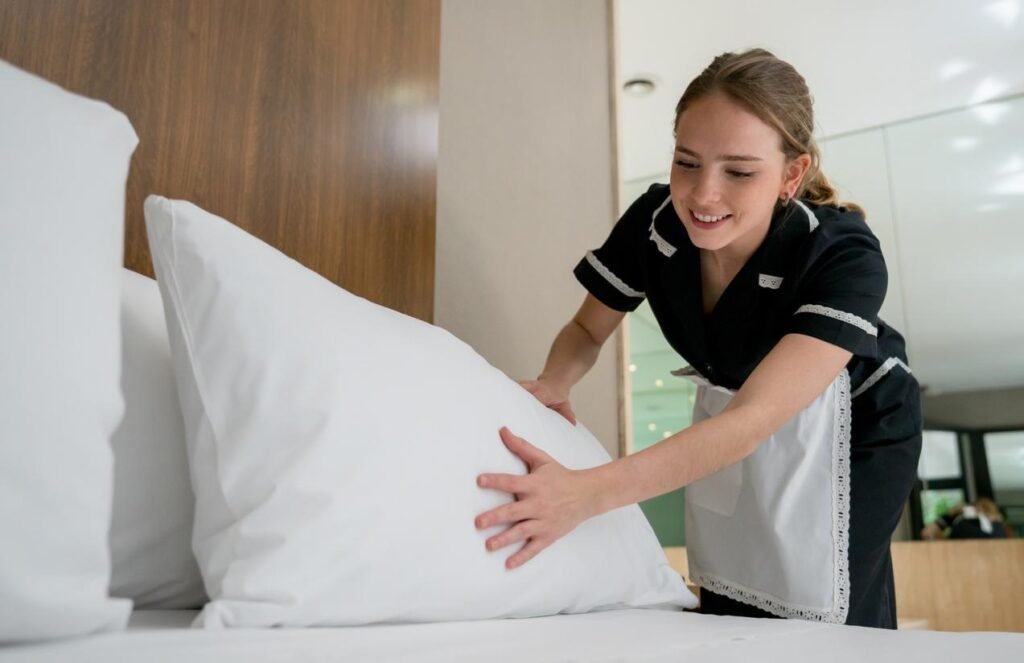
The 3-Layer System Hotels Actually Use
Housekeeping teams don’t treat “the pillow” as one object. They treat it as three separate hygiene zones, each with its own cleaning rules.
Layer 1: The Pillowcase- Washed Every Single Checkout
This is the one layer almost no hotel skips. Industry reporting confirms that basic sheets and pillowcases are washed between each guest at nearly every reputable property; it’s the closest thing to a universal standard in hotel housekeeping. It’s the fabric in direct, sustained contact with your face, hair, and skin oils, so it gets laundered on every turnover regardless of hotel tier.
Layer 2: The Pillow Protector- The Hygiene Workhorse
Between the pillowcase and the pillow, there sits a zippered protector that is often waterproof or hypoallergenic, and most guests never notice this. Hotels use these protectors specifically to extend hygiene between full pillow washes. This layer absorbs sweat, oils, and drool before they ever reach the pillow’s fill, and it’s laundered far more often than the pillow itself.
Quality varies by construction:
- Cotton-based protectors are typically laundered around 60°C (140°F), the temperature widely used industry-wide because it effectively eliminates dust mites and common pathogens.
- Waterproof or hypoallergenic membrane protectors follow gentler manufacturer care instructions, since some membranes start to degrade above 60°C.
- Well-made protectors are engineered to withstand roughly 200 to 300 industrial wash cycles before their performance declines, which is why hotels can wash this layer aggressively without needing to replace it constantly.
Layer 3: The Pillow Itself- Periodic Deep Clean or Replacement
The pillow’s inner fill is the hardest layer to clean and the slowest to rotate. Industry patterns break down roughly like this:
| Hotel Tier | Pillow Washing/Deep-Clean Frequency | Pillow Replacement |
| Economy | Once or twice a year, if at all | 1–2 years |
| Mid-range (2–4 star) | Every 3–6 months | 12–18 months |
| Luxury / high-service | More frequent; some brands wash between stays | 6–12 months |
Some major chains, including Marriott, have publicly stated their pillows are washed between every guest stay, though that level of turnover is more common at the higher end of the market. As one hospitality expert put it in industry coverage: the higher the level of service, typically the higher the frequency of cleaning.
The Science: Why Hot Water Is Non-Negotiable
Hotels don’t wash bedding hot just for appearances, there’s real microbiology behind the temperature choices, and the research is more dramatic than most people expect.
A peer-reviewed study on household dust mites, published in the medical literature and later cited by allergy specialists, found that mites were reliably killed only at water temperatures of 55°C or higher, and that lower temperatures weren’t made more effective by any detergent tested. In other words, heat, not soap, is the variable that actually matters.
The gap between “warm” and “hot” is enormous. Research presented at the American Thoracic Society’s international conference found that washing at 60°C (140°F) or higher kills all house dust mites essentially, compared with only about 6.5% killed at 40°C (104°F).
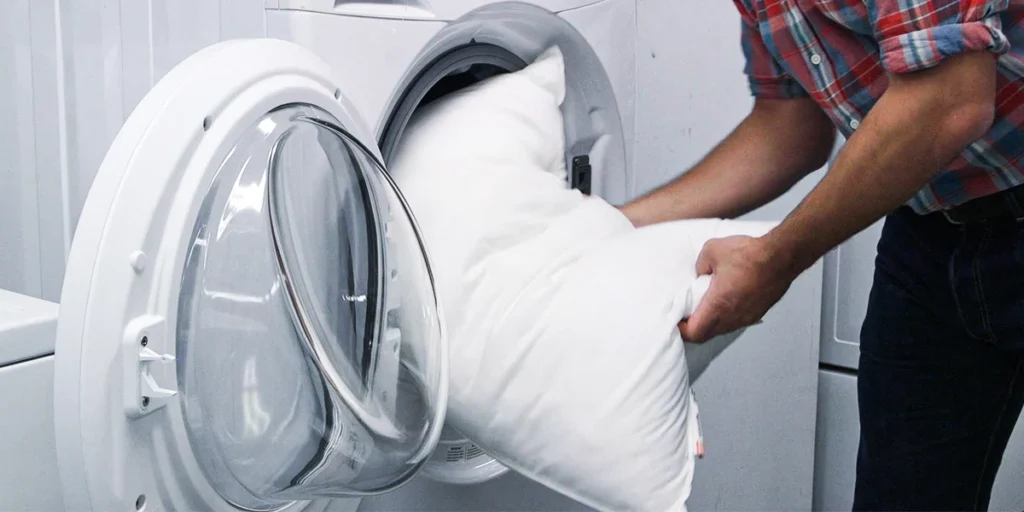
The same research showed hot-water washing removed nearly 90% of pet dander and around 97% of pollen from fabric, versus far lower removal rates at cooler settings. More recent commentary from infection-prevention researchers reinforces the same point: a standard 40°C machine wash can leave the vast majority of dust mites alive in bedding.
This is precisely why commercial hotel laundries operate so much hotter than a home washing machine. Hotel laundry facilities commonly run at 60–90°C with commercial-grade detergents and high-speed extraction, conditions that break down fabric fibers faster than home washing, but that are also the only conditions shown to reliably neutralize dust mites and the allergens they leave behind.
What Hotel-Grade Laundering Costs the Pillow (And Why That Matters to You)
Here’s a detail most guests never think about: hotel pillows work far harder than the one on your bed at home. High-occupancy hotel pillows may see 200–300 nights of use per year, and the same industrial heat that kills mites also accelerates wear.
Some estimates suggest a pillow washed monthly under industrial conditions experiences roughly the equivalent of three to four years of home washing within a single year of hotel service.
This is why fill quality directly determines how often a hotel needs to replace its pillows:
- Lower-density polyester fill (under roughly 600g) tends to lose resilience after just 30–50 wash cycles, leaving pillows flat and unsupportive, a complaint guests notice almost immediately.
- Premium microfiber or spiral-cut hollow-fiber fills at higher fill weights (800–1,000g) can retain their loft through 80–120 wash cycles, often roughly doubling the pillow’s usable life.
- The outer shell matters too: hotel-grade shells commonly use 233–300 thread count cotton or cotton-polyester blends with reinforced seams, since a weaker shell tends to fail before the fill itself is worn out.
So, when a pillow at a nicer hotel feels noticeably plusher and holds its shape better than one at a budget property, that’s not just marketing; it’s a direct result of fill density and wash-cycle durability.
The Part of the Bed Hotels Clean Least, And Why
If you’re going to be cautious about anything on a hotel bed, research suggests it shouldn’t be the pillowcase; it should be the decorative throw pillows. Hospitality industry sources note that decorative pillows and blankets sit on a separate cleaning cycle from sheets and pillowcases, with a 60- to 90-day interval being fairly typical, and some hotels reportedly washing decorative bedding as infrequently as four times a year.
The reasoning is practical rather than neglectful: these items simply don’t come into the same direct, sustained contact with guests that sheets and pillowcases do. Housekeeping staff still check them against a standard operating checklist, though, and will pull or clean any item with a visible stain regardless of the regular schedule.
Practical takeaway: the sleeping pillow under its case is one of the more rigorously cleaned items in the room. The decorative accent pillow perched on top is the one worth setting aside before you get into bed.
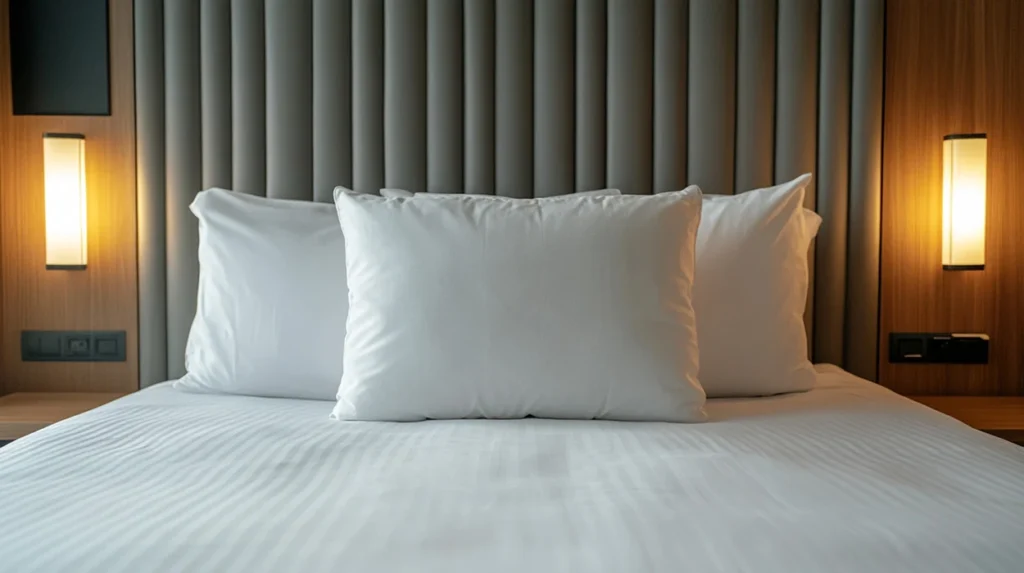
Why This Matters: Guests Are Actually Paying Attention
This isn’t a niche concern. A survey by the American Hotel & Lodging Association (AHLA) found that cleanliness is the single top factor travelers weigh when choosing a hotel, with roughly 81% of frequent travelers saying they specifically prefer hotels that demonstrate strong cleaning habits.
Hotel brands know this, which is part of why washing the pillowcase at every checkout has become a near-universal baseline rather than an aspirational standard.
At the same time, there’s no single universal standard governing every layer of hotel bedding. Industry bodies such as the AHLA and the International Executive Housekeepers Association (IEHA) recommend regular washing schedules and at least one full deep clean per year, but actual frequency still varies by property, brand tier, and individual management.
That gap between published guidelines and day-to-day practice is exactly why understanding what’s happening layer by layer is useful for travelers who care about the details.
5 Things You Can Do to Sleep Cleaner in Any Hotel
- Skip the decorative throw pillows. Move them off the bed before you settle in; they’re the least frequently cleaned soft item in the room.
- Ask before you book if it matters to you. Most hotels will describe their bedding schedule directly; a quick call or email can confirm pillow and protector washing frequency for that specific property.
- Bring a travel pillow protector. A packable, zip-close protector adds your own hygiene layer on top of the hotel’s, especially useful for longer stays where housekeeping may skip full linen changes between cleanings.
- Do a quick visual and smell check. Crisp, unwrinkled pillowcases with no odor are a reasonable sign of a fresh change; anything off is worth flagging to the front desk.
- Choose established chains for predictability. Major brands generally follow documented, chain-wide standards, while independent boutique properties and short-term rentals can vary considerably with no consistent baseline.
Replacement Schedules: Knowing When to Retire a Pillow
Washing a pillow too frequently destroys its structural integrity and support. Most hotel chains maintain strict rolling retirement timelines rather than over-washing:
- Economy / Mid-Scale Hotels: Replace synthetic pillows every 12 to 18 months.
- Luxury / 5-Star Properties: Replace down and luxury fiber pillows every 18 to 24 months, or immediately upon failing inspection.
- Inspection Benchmarks: Housekeeping inspects pillows during every room turnover. Any pillow exhibiting permanent yellowing (lactic acid staining), flat spots, or failure to bounce back during a fold test is immediately decommissioned.
Do Hotels Wash Pillows Between Guests?
Not necessarily.
Hotels generally change pillowcases between guests, while the pillow itself may be protected by a washable cover and cleaned according to a scheduled housekeeping procedure.
If a hotel pillow becomes visibly dirty or contaminated, it should be removed for cleaning or replacement rather than simply being covered with fresh linen.
This is an important distinction when asking, “Do hotels wash pillows?”
The answer is sometimes, but not necessarily after every guest.
The exact procedure varies between properties.
Do Hotels Use Pillow Protectors?
Yes, pillow protectors are widely used in hotel housekeeping because they provide an additional barrier between the guest and the pillow.
A pillow protector can:
- Reduce direct exposure of the pillow to sweat and body oils.
- Help prevent moisture from reaching the filling.
- Make cleaning easier.
- Protect the pillow from stains.
- Extend the usable life of the pillow.
- Provide an additional barrier against allergens.
For people concerned about dust mites and allergens, an allergen-impermeable pillow cover can provide additional protection. The American Cleaning Institute specifically recommends dust-mite-proof pillow covers as part of an allergen-control strategy.
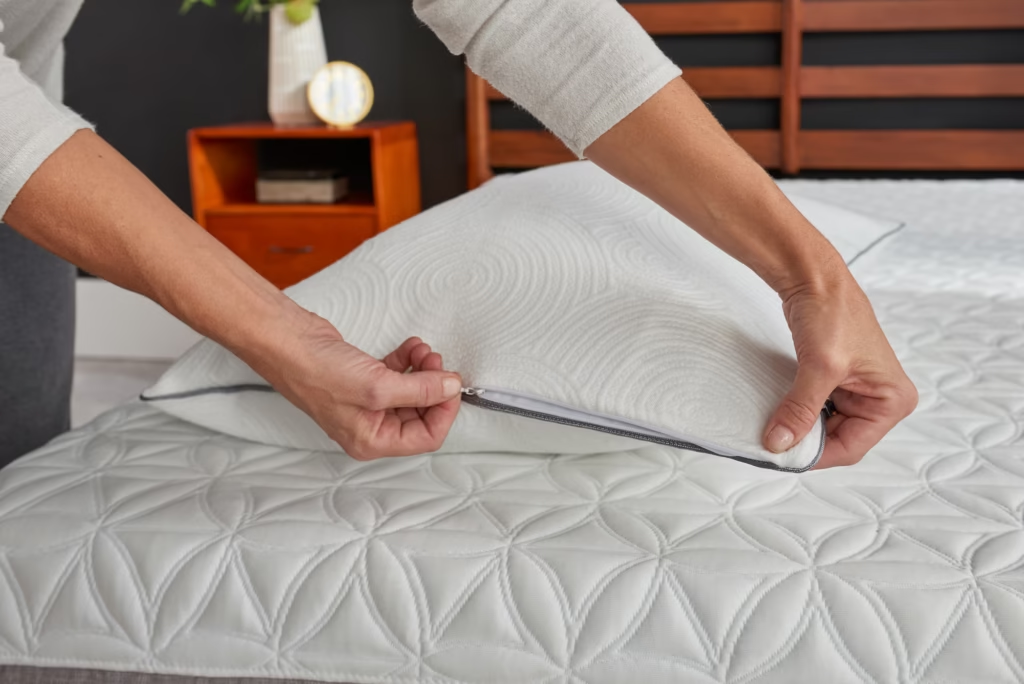
Can You Trust a Hotel Pillow?
For most reputable hotels, the bedding and housekeeping process is designed specifically to prepare the room for the next guest.
However, hygiene standards and housekeeping practices can vary considerably between properties.
If you are particularly sensitive to allergens, one practical precaution is to bring your own pillow or use a personal pillow protector when traveling.
You can also look for hotels that clearly communicate their housekeeping and linen policies.
It is worth remembering that a fresh-looking pillowcase does not tell you everything about the condition of the pillow underneath.
How Is Hotel Pillow Cleaning Different From Cleaning a Pillow at Home?
The basic principles are similar, but hotels have some important advantages.
A hotel may process hundreds or thousands of pieces of bedding through commercial laundry systems. These systems are designed for high-volume cleaning, controlled temperatures, standardized cycles, and rapid drying.
At home, the biggest challenge is often knowing whether a pillow can safely be machine washed and whether it can be dried completely.
For home use, always check the manufacturer’s care label before washing a pillow.
This is especially important for memory foam, latex, down, and specialty pillows, because their cleaning requirements can differ substantially.
The Bottom Line
Hotels keep pillows clean through layered defense, not a single step: pillowcases washed at every checkout, protectors laundered on a tight rotation at dust-mite-killing temperatures (55–60°C and above), and the pillows themselves deep-cleaned or replaced every few months to a couple of years depending on the property’s tier.
The most important takeaway is that a clean hotel pillow is the result of regular linen changes, protective barriers, proper laundering, complete drying, inspection, and timely replacement.